
What Chicken Road Actually Is
Strip away the branding and Chicken Road is a simple idea dressed up in a fun theme: you advance a chicken, step by step, along a lane, and every step you clear raises a multiplier sitting on top of your stake. You can stop and take that multiplier at almost any point. Keep going and the multiplier keeps climbing, but so does the chance that the next step doesn't go your way — and if it doesn't, the round ends and the stake you placed on it is gone.
That's the entire mechanic. There's no hand of cards to read, no reels to learn, no board position to track. One decision repeats itself every step: keep going, or cash out now. Everything else — the theme, the animation, the difficulty mode you've picked — sits on top of that one repeating choice.
It's worth being precise about what kind of game this is, because the label people reach for varies. It's commonly grouped with "instant" or "crash-style" casino games — titles that resolve in seconds rather than dealing out a hand or spinning a set of reels — and some players describe it informally as slot-adjacent because of where it tends to show up in a casino lobby. None of those labels changes the mechanic itself: advance, watch the multiplier, decide.
We're deliberately keeping this section short. If you want the deeper mechanics — RTP, volatility curves, how the multiplier math is built — that's a worthwhile but separate rabbit hole, and a mechanics-focused resource like Chicken Road Hub goes into that depth properly. This page exists for the question that comes before all of that: do you actually understand and feel ready for the basic loop, and have you checked the practical things that matter before you open a real round?

How a Round Plays Out
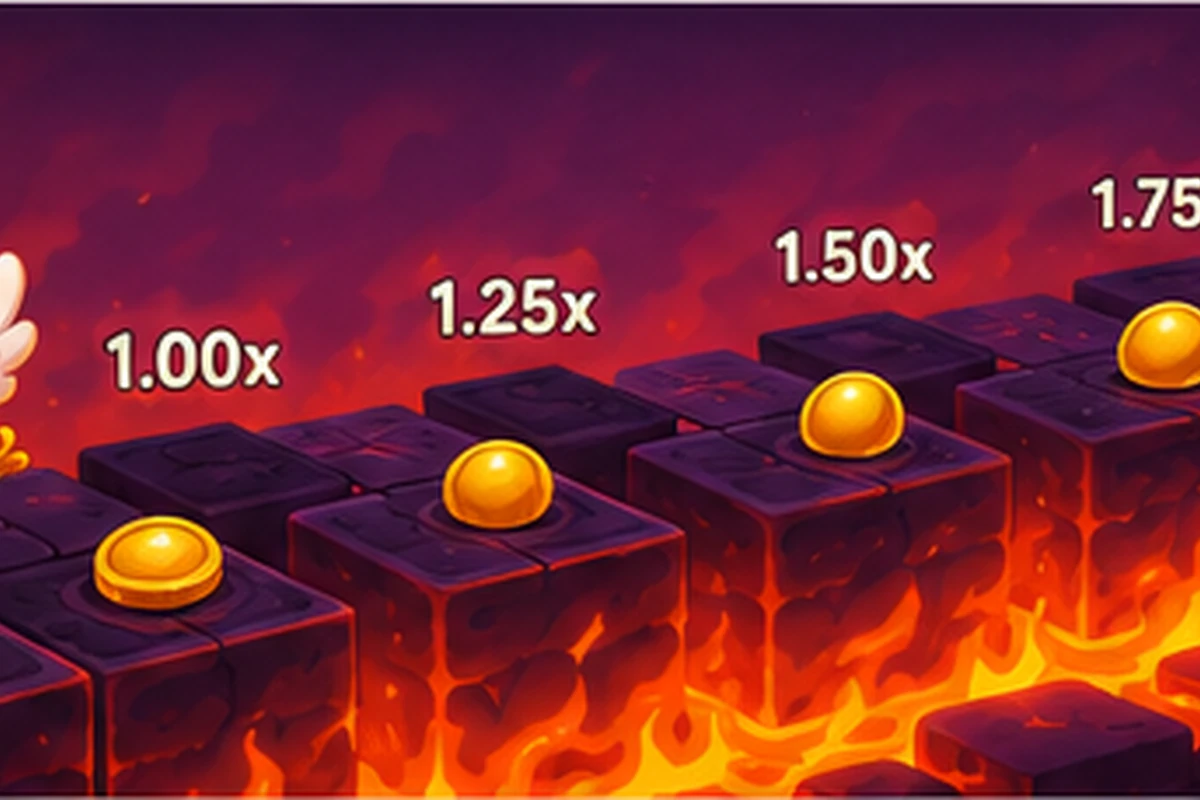
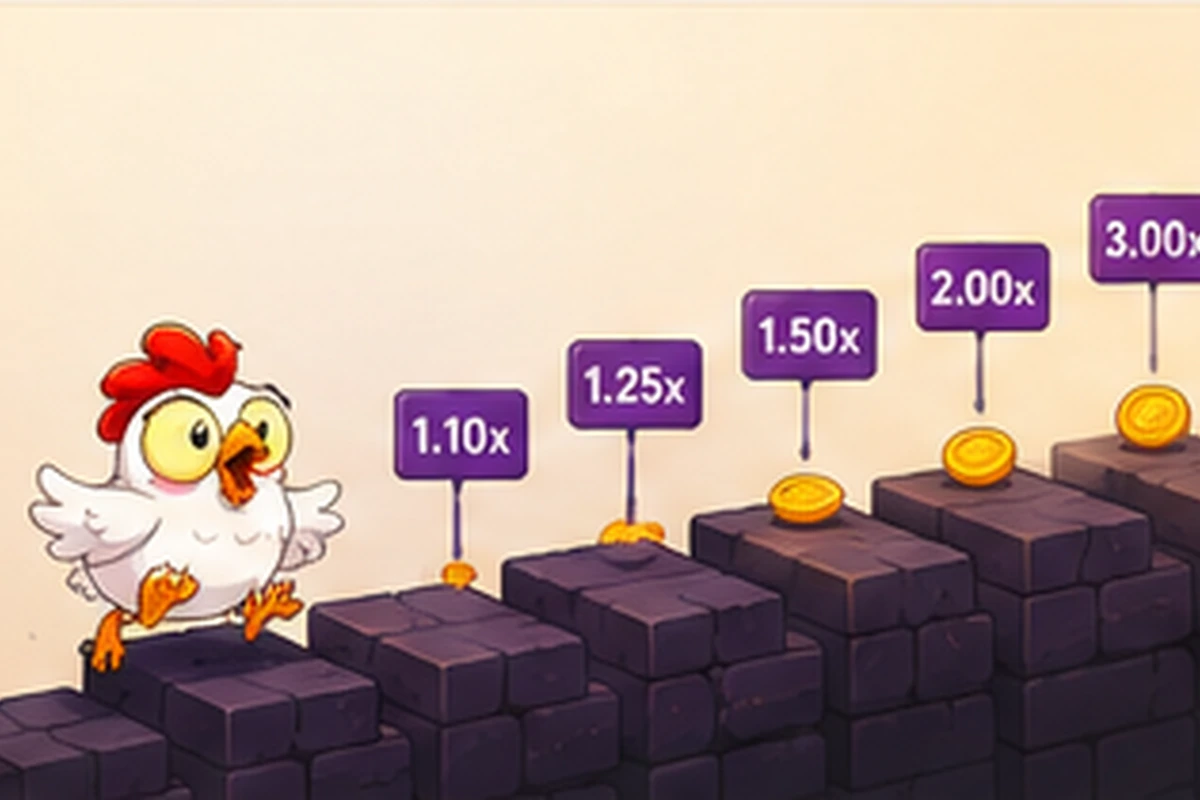
A round starts the moment you place a stake and pick a difficulty mode. From there, the chicken sits at the first step of the lane, and a single control lets you send it forward. Clear that step and the displayed multiplier ticks up; the chicken is now standing further along the road than it started, and the amount you'd receive by cashing out right now is higher than it was a moment ago.
You get a genuine choice after every single step: take the current multiplier and end the round on your terms, or push forward for a bigger number. There's no set number of steps you're required to take, and no penalty for cashing out early beyond the obvious one — you leave a potentially bigger multiplier on the table. That tension, repeated every few seconds, is the entire game.
A round ends one of two ways: you choose to cash out, which locks in whatever multiplier you'd reached, or a step fails, which ends the round immediately and forfeits the stake for that round. There's no partial credit for getting most of the way along the lane — the outcome of each round is binary once it's over, even though the decision that led there was made one step at a time.
What makes this worth understanding before you play, rather than after, is that the pacing is fast. A round can be over in well under a minute. That speed is part of the appeal, but it also means there's very little time to think through a decision mid-round that you haven't already thought through in advance — which is exactly what the readiness checklist further down this page is for.
Difficulty Modes, Briefly
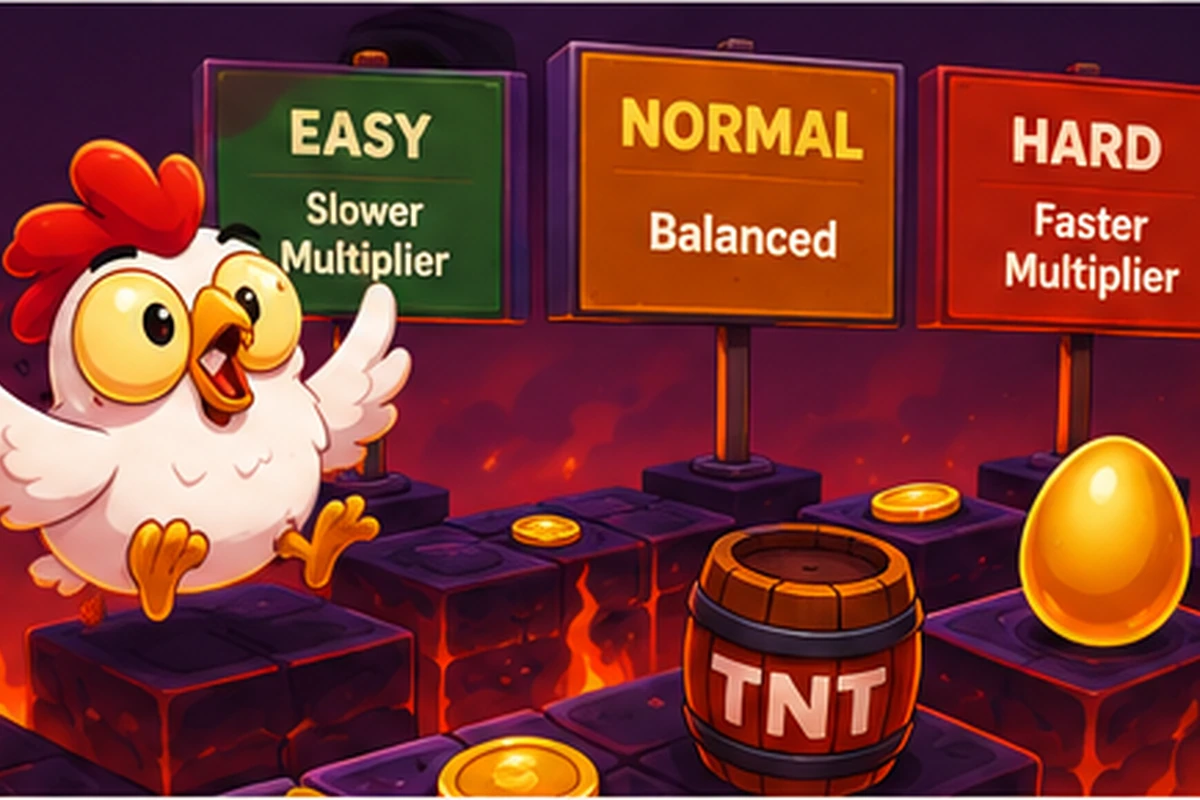
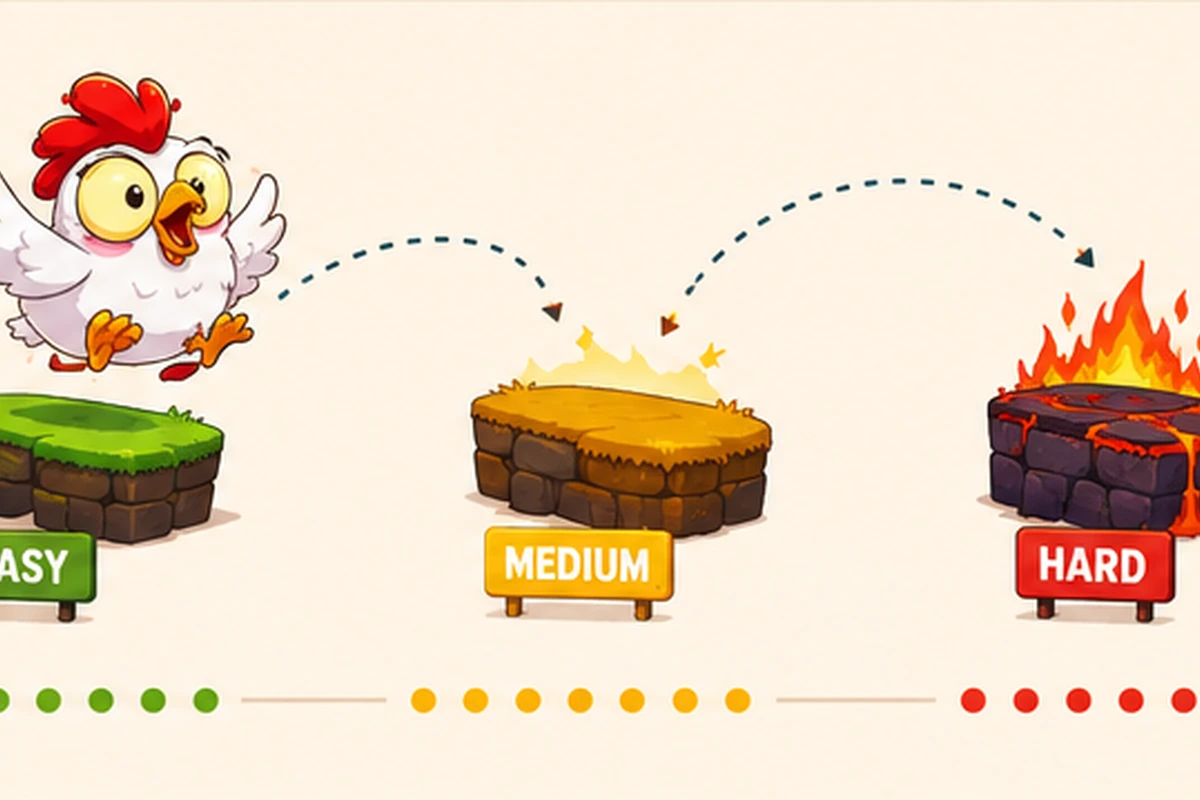
Most versions of Chicken Road let you choose a difficulty mode before a round starts, and the mode you pick changes two things at once: how likely each individual step is to succeed, and how quickly the multiplier climbs as a reward for taking on that extra risk. A gentler mode fails less often per step but grows the multiplier more slowly; a harder mode raises the multiplier faster per step but fails more often.
For a genuine first-timer, the practical advice is short: start on Easy. It gives you the most room to learn the rhythm of the game — how fast rounds move, how the cash-out decision feels under a little bit of real pressure — without the steepest version of that pressure on your very first attempts. You can always try a harder mode once the basic loop feels familiar rather than novel.
We're intentionally not turning this into a full volatility breakdown. Comparing every mode's odds and multiplier curve in detail is a legitimate deep dive, and it's the specific job of a mechanics-focused resource like Chicken Road Hub — a site built around exactly that kind of dial-by-dial comparison. What matters for a first session is simpler: know that the modes exist, know that they trade risk for pace, and default to the gentlest one until you've played enough rounds to have a real preference.
The First-Play Readiness Checklist
This is the actual point of this page. Understanding the mechanic is one thing; being genuinely ready to open a real-money round is a separate, more practical question, and it comes down to five checks that take a few minutes total the first time and become second nature after that.
None of these checks require special expertise. They're the same kind of sensible, five-minute habits worth running before trying any new online gambling-adjacent product for the first time — just applied specifically and honestly to a first Chicken Road session.
| Checklist item | Why it matters | How to check it |
|---|---|---|
| Age & province | Canadian legal gambling age is set by province, not one national rule | Confirm 18+ (Alberta, Manitoba, Quebec) or 19+ (most other provinces) applies to you, and that any operator states it clearly |
| Genuine listing | Fake clone apps and spoofed listings exist for popular games like this one | Confirm the app, site or listing traces back to a real, checkable operator identity — not an unfamiliar download link with no public footprint |
| Demo before real money | A free-play round shows you the pacing and mechanics with nothing at stake | Play a handful of demo rounds first, on the same operator you're considering for real money |
| Budget & session limit | Fast-paced rounds make it easy to keep going without a pre-set stopping point | Decide on a spending limit and a time limit before you start — not partway through a session |
| Cash-out is a decision, not a guarantee | Every round can end in a forfeited stake, no matter how many rounds went well before it | Go in accepting that any single round's stake could be lost, and never treat a past winning streak as a reason to skip this checklist next time |
Why this checklist, and not a longer one
We kept this to five items on purpose. A checklist that's too long doesn't get followed; a short one that actually gets run through every time is worth more than a comprehensive one that gets skipped after the first session. If you want to go deeper on any single item — verifying a listing, comparing difficulty modes, evaluating a specific operator — those are each their own focused topic, and resources like Chicken Road Official, Chicken Road Hub and Chicken Road Info cover them in the depth this page deliberately doesn't attempt.
Common First-Timer Mistakes
Most of the trouble first-time players run into isn't about the game itself — it's about skipping one of the checklist items above under the pressure of a fast-moving round. Here are the patterns worth watching for specifically.
Skipping the demo entirely
Jumping straight to a real-money round without ever seeing how fast a round moves or how the cash-out control actually feels means your first real decision is also your least-informed one.
Choosing a hard difficulty mode first
A steeper mode's faster multiplier growth is tempting, but it also fails more often per step — a rough way to learn the rhythm of a round for the very first time.
Setting a budget "roughly," in your head
A limit you haven't written down or committed to before starting tends to quietly move as a session goes on. Decide the number before you open the first round, not while you're mid-session.
Chasing one good round with a bigger stake
A strong result on one round says nothing about the next one. Increasing your stake specifically to "make up for" an earlier loss is one of the fastest ways a small loss becomes a large one.
Not confirming the listing is genuine
Because the game's name is widely searched, it attracts clone apps and spoofed listings. A five-minute check before you download or deposit is worth far more than the minute it costs you.
Treating a "close call" as a system to exploit
A round that almost failed and then didn't is not a sign the next step is safer. Each step's outcome doesn't remember what happened on the step before it.
Checking Availability in Canada
This is the honest answer to "where do I actually play for real money," and it's deliberately not a list of names. This site has not verified a specific real-money operator as of this writing, so rather than point you at an unverified link and call it a recommendation, here's what checking availability actually involves.
Start with your province. Canadian gambling regulation is set at the provincial level, not nationally, so whether a given operator is properly authorized to serve you depends on where you live, not on the operator's own claims about itself. Look for a specific, named licensing authority in an operator's footer or terms — not just the word "licensed" on its own with nothing to check it against.
From there, the same genuine-listing check from the readiness checklist above applies at the operator level too: a real operator has a checkable company identity, a track record that shows up somewhere other than its own homepage, and terms that plainly state withdrawal limits and processing times before you deposit, not after. If any of that is missing or vague, treat it as reason to keep looking rather than reason to proceed anyway.
We'd rather say plainly that we haven't done this verification work yet than publish a rushed list. Once we have, this section will name what we've checked and how. Until then, treat "checking availability" as a short process you run yourself, using the same honest standard this page uses everywhere else.

Casinos & Payment Methods
We're not going to name a specific casino here — see the section above for why. What we can give you, honestly and without needing to verify any one operator first, is how the payment methods you'll run into actually behave: which ones are fast, which ones are one-way, and which ones quietly cost you time or money if you pick the wrong one for what you're trying to do.
| Method | Deposit speed | Withdrawal speed | Typical fees | Watch for |
|---|---|---|---|---|
| Interac e-Transfer | Instant to a few minutes | Same day to 1 business day, at operators that support it for payout | Usually free | Not every operator accepts it for withdrawals even when they accept it for deposits — confirm both directions, not just one |
| Visa / Mastercard | Instant | 3–5 business days, sometimes longer | Usually free to deposit; some operators charge on withdrawal | The slowest common method for getting money out — a bad fit if withdrawal speed matters to you |
| Prepaid vouchers | Instant | Not supported — deposit-only at almost every operator | A small purchase fee where you buy the voucher | You'll need a second method on file just to withdraw, so plan for that before you deposit, not after you win |
| E-wallets | Instant | Often within 24 hours | Set by the wallet provider, not the casino | Availability to Canadian accounts varies by provider — confirm yours is actually supported before assuming |
| Crypto (where permitted) | Minutes, network-dependent | Minutes to a few hours | Network fees; rarely an operator fee on top | Only usable where the operator explicitly discloses support for it and it's permitted where you live — never assumed |
How to Read Any Casino's Payment Page in Two Minutes
Before you enter a card number or send an e-Transfer anywhere, a genuine payment page should answer these five things without you having to dig or contact support first:
A named licensing authority
Not just the word "licensed" — a specific regulator (for example, a provincial authority or a recognized gaming commission) that you could look up independently.
Minimum and maximum limits, stated upfront
Deposit and withdrawal limits should be listed before you start, not discovered when a transaction gets rejected.
Withdrawal times in business days, not vague promises
"Fast withdrawals" isn't a number. A trustworthy page states an actual processing window per method, like the ranges in the table above.
ID verification disclosed before you deposit
Most legitimate operators require identity verification before a first withdrawal. That should be stated upfront, not sprung on you afterward as a surprise delay.
A support channel that works before you've deposited
Try the chat or contact link before you commit any money. If it's unresponsive or missing at this stage, it isn't likely to improve once you're a depositing customer.
Where Canadian Licensing Is Actually Decided
We won't name a private casino brand as verified, but the official registries below are real and checkable right now — they're the actual source of truth for whether an operator is authorized, not a private list we've assembled ourselves.
| Province / body | What it is | Why it matters here |
|---|---|---|
| Ontario — iGaming Ontario | The provincial regulator's own public registry of operators authorized to offer online casino games in Ontario | The definitive list for Ontario — an operator not on it isn't authorized there, regardless of what its own site claims |
| British Columbia, Manitoba, Saskatchewan — PlayNow | The single government-operated online gambling platform for these provinces | In these provinces, the government platform itself is the primary legal option, not a private operator |
| Quebec — Espacejeux (Loto-Québec) | Quebec's government-operated online casino platform | Same pattern as BC/MB/SK: the provincial platform, not a private brand, is the primary legal option |
| Kahnawake Gaming Commission | A licensing body based in Quebec that licenses many operators serving players across Canada and internationally | A real, checkable license — but licensing by Kahnawake alone doesn't automatically make an operator authorized under a specific province's own regulator (e.g. Ontario's) |
| Alberta and most other provinces | No dedicated province-run online casino registry as comprehensive as Ontario's as of this writing | Regulation here leans more on the operator's own disclosed licensing — which is exactly why the checklist above matters most in these provinces |
Operators Currently Authorized in Ontario
Ontario is the one province with a full public registry, so it's the one place we can name real operators without guessing. As of iGaming Ontario's own listing (2026-08-06), 48 operators run 83 gambling websites under Ontario authorization. Recognizable names on that registry include:
Being on this registry confirms one specific thing: the operator is authorized to run an online casino site in Ontario. It does not confirm that any of them currently carries Chicken Road specifically — game catalogues change constantly, we haven't checked each one, and a game available today can be gone tomorrow. It also only speaks to Ontario: an operator on this list isn't automatically authorized in every other province. Treat this as a verified starting point for "is this a real, licensed business," not a confirmation of "this has the exact game I want."
Why this list stops where it does
The Ontario registry above is a public record we can cite and date. Whether a specific one of those operators has Chicken Road in its library right now, or whether it's the right choice for your province, is exactly what the readiness checklist and the "before you deposit" list above ask you to confirm yourself — we'd rather hand you a real, sourced starting point than a confident-sounding guess about game availability we can't actually verify.
Demo First: Building the Habit
If there's one habit worth taking from this entire page, it's this one: play the demo before you play for real money, every time you try a new operator, not just the very first time you try Chicken Road. A genuine free-play demo runs the real mechanics with nothing staked, which does two useful things at once.
First, it teaches you the pacing and the cash-out control without any financial pressure attached, so your first real-money round isn't also the first round where you've actually had to make the decision under pressure. Second, a working demo that matches what's publicly known about the game is itself a quiet sign that the listing you're looking at is genuine — a clone would have to rebuild working mechanics rather than just copy an icon and a description.
A demo can't tell you everything, though. It won't tell you whether a specific operator is properly licensed for your province, or how they'll handle a withdrawal months from now — those are the operator-level checks from the previous section, and they're a separate question from whether the game itself is genuine. Treat the demo as step one of getting ready, not the whole process.
Make it a standing habit rather than a one-time box to tick: new operator, new demo session first, every time. It costs a few minutes and nothing else, and it's the single most effective thing a genuine first-timer can do before opening a real round.
Responsible Play
A readiness checklist covers whether you understand the game and have checked the practical basics. It says nothing about whether playing is a good idea for you right now. Gambling involves financial risk regardless of how prepared you are, and no outcome is ever guaranteed.
- Play is intended for adults only — 18+ in Alberta, Manitoba and Quebec; 19+ in most other provinces and territories.
- Set a spending limit and a time limit before your session starts, not during it.
- Treat any stake as money you've already accepted losing, not money in transit.
- Most licensed operators offer deposit limits, cool-off periods and self-exclusion tools — use them if a session stops feeling like entertainment.
- If gambling ever feels out of your control, Canada-wide and provincial support resources are listed on our Responsible Gaming page.
This site does not accept real-money wagers and does not operate any casino. It is informational only.
Frequently Asked Questions
It's an instant-round casino game where you advance a chicken step by step along a lane. Each step you clear raises a multiplier on your stake. You choose when to stop and cash out; if a step fails, the round ends and the stake for that round is lost.
No. The core idea — advance, watch the multiplier grow, decide whether to stop — is simple enough to follow on a first look. This page is written specifically for someone who has never played anything like it before.
It depends on your province: 18+ in Alberta, Manitoba and Quebec, and 19+ in most other provinces and territories. Always confirm the exact requirement with any operator directly before playing.
Yes. A free-play demo lets you see the core loop, the pacing, and how a difficulty mode changes the feel of a round with nothing at stake. It's the single most useful habit for a first-timer, and it's the second CTA on this page for exactly that reason.
Easy is the usual starting point — smaller per-step risk and a gentler multiplier curve while you're still learning the rhythm of a round. A deeper comparison of the modes and how each one changes volatility is its own topic that a mechanics-focused resource covers in more depth than this page attempts to.
Check that the listing or operator traces back to a real, checkable identity rather than a generic download link or an unfamiliar app with no public footprint. Verifying app and listing authenticity in more depth is a narrow, dedicated topic in its own right if you want to go further than the quick check on this page.
That depends on your province and on whether a specific operator is properly licensed there — Canadian gambling regulation is set province by province, not nationally. Confirming that is part of the same readiness habit this page is built around, not a yes/no answer that applies everywhere.
No, not yet. We haven't verified a specific real-money operator as of this writing, so rather than pretend otherwise, this page explains what checking one actually involves and points you to that process instead of a button that quietly sends you somewhere unverified.
Commonly Interac e-Transfer, Visa or Mastercard, prepaid vouchers, select e-wallets, and sometimes crypto where it's permitted. Which of these a specific operator actually offers, and how fast withdrawals move, is exactly the kind of detail worth confirming directly before you deposit.